Our team sees the same panic set in every winter. A sudden icy shower usually forces a fast, rushed decision. Homeowners and property managers frequently accept the first quote they receive just to restore the comfort of their household.
We want to change that reactive approach. Getting a clear picture of what a hot water system should cost right now gives you immediate negotiating power.
The market has shifted significantly in 2026.
So, let’s explore the data to answer a common question: How Much Does Hot Water System Replacement Cost in Sydney? We will break down current pricing, compare fuel types, and explain exactly how the latest point-of-sale rebates work.
Hot Water System Replacement Costs by Type
If you are asking “How Much Does Hot Water System Replacement Cost in Sydney?”, the answer completely depends on the fuel source and technology you choose. The initial hardware price is only one part of the equation.
Our installers track these hardware prices daily to ensure fair quotes.
Electric Storage Hot Water Systems
| Tank Size | Suitable For | Supply + Install Cost |
|---|---|---|
| 25L - 50L | Single person / small unit | $800 - $1,200 |
| 80L - 125L | Couple / small apartment | $1,000 - $1,600 |
| 160L - 250L | Family of 3-4 | $1,200 - $2,000 |
| 315L - 400L | Large family (5+) | $1,500 - $2,500 |
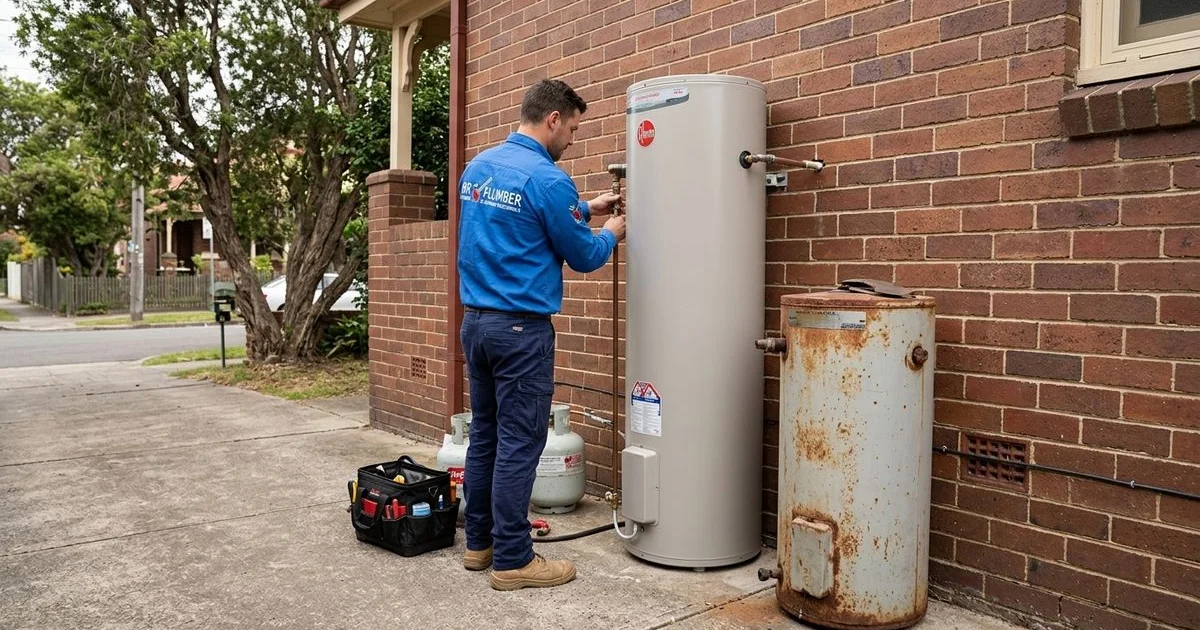
Electric storage tanks remain the most common replacement choice for properties that cannot access gas. Replacing an existing unit in the exact same location is the most budget-friendly route.
We often recommend sticking with established brands for these basic setups. Rheem units have a vitreous enamel factory located right in Rydalmere. This local manufacturing presence means replacement parts are always accessible across the city.
Dux Proflo tanks offer another excellent local alternative. These models are typically 10 to 15 percent cheaper than their Rheem equivalents. A standard 315L Dux twin element heater usually costs around $1,925 fully installed.
Gas Storage Hot Water Systems
| Tank Size | Suitable For | Supply + Install Cost |
|---|---|---|
| 90L - 135L | Couple / small household | $1,200 - $1,800 |
| 170L - 260L | Family of 3-4 | $1,500 - $2,200 |
| 340L - 400L | Large family (5+) | $1,800 - $2,800 |
Gas storage units provide faster recovery times than standard electric elements. These systems are highly effective for homes running multiple showers during the busy morning rush.
Our gasfitters frequently replace aging Vulcan and Rinnai storage tanks in older suburban properties.
Homeowners should note that the NSW Government is actively encouraging a transition away from gas. Because of this push, you will not find government rebates available for installing new gas storage tanks in 2026.
Gas Instantaneous (Continuous Flow)
| Flow Rate | Suitable For | Supply + Install Cost |
|---|---|---|
| 16L/min | 1 bathroom | $1,500 - $2,200 |
| 20L/min | 1-2 bathrooms | $1,800 - $2,800 |
| 26L/min | 2-3 bathrooms | $2,200 - $3,500 |
| 32L/min | 3+ bathrooms | $2,800 - $4,000 |
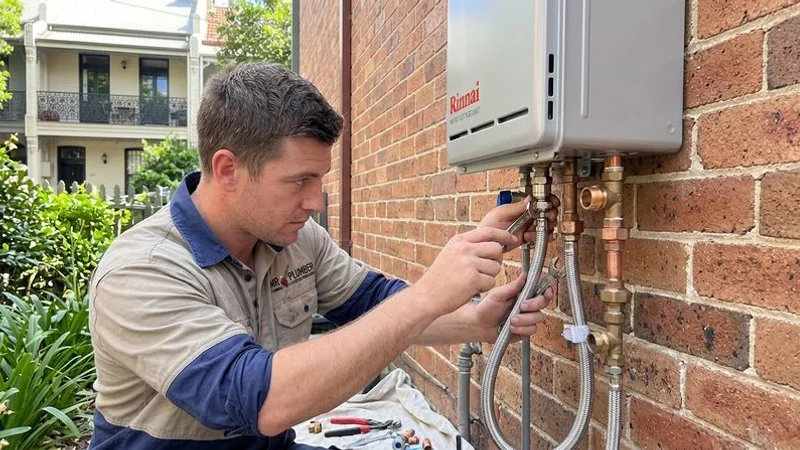
Gas instantaneous units mount directly to the wall and only ignite when a tap is turned on. Rinnai is currently the market leader in this category. Their high-efficiency continuous flow systems come with a 12-year warranty on the heat exchanger.
We see immense demand for these units in tight, high-density areas. Space-saving designs make them perfect for narrow terraces in Paddington and balcony installations across Bondi Junction.
Upgrading from a storage tank to an instantaneous unit often requires a larger gas pipe. Continuous flow systems pull a massive amount of gas very quickly to heat water on the fly. Upgrading an old 15mm gas line to the required 20mm pipe can add several hundred dollars to your installation bill.
Heat Pump Hot Water Systems
| Tank Size | Suitable For | Supply + Install Cost | After Rebates |
|---|---|---|---|
| 150L - 200L | Couple / small household | $3,000 - $4,000 | $2,000 - $3,000 |
| 250L - 300L | Family of 3-4 | $3,500 - $4,500 | $2,500 - $3,500 |
| 315L - 400L | Large family (5+) | $4,000 - $5,500 | $3,000 - $4,500 |
Heat pumps extract ambient warmth from the outside air and use a refrigerant cycle to heat your water. These units deliver up to 75 percent energy savings compared to traditional electric elements.
Our preferred options for these high-efficiency upgrades include the Dux Airoheat and premium Stiebel Eltron models. Stiebel Eltron stands out by offering an impressive 10-year warranty on heat pump components.
The higher upfront purchase price is offset by aggressive state funding. The current NSW upfront discount model applies the savings directly to your quote, meaning you pay the reduced price on installation day.
What’s Included in the Installation Cost?
A legitimate quote must be completely transparent about what happens on the day of the job. A standard replacement installation typically includes several non-negotiable steps.
- Disconnection and removal of the old system
- Supply and delivery of the new unit
- Installation including plumbing connections
- Electrical or gas connection (performed by licensed trades)
- Commissioning and testing the new system
- Basic compliance certificate
We always issue a Certificate of Compliance (CCEA) upon completion. Fair Trading NSW mandates this certificate to prove the work meets all current safety regulations. Failing to secure this document can instantly void your manufacturer warranty.
What Might Cost Extra?
| Additional Work | Approximate Cost |
|---|---|
| Relocating the unit | $300 - $800 |
| New gas line installation | $500 - $1,500 |
| Electrical switchboard upgrade | $1,000 - $1,800 |
| Tempering valve installation | $150 - $350 |
| Concrete base or stand | $150 - $400 |
| Old system disposal (asbestos tank) | $200 - $500 |
Switchboard upgrades represent the most significant hidden cost during an installation. Modern heat pumps and continuous flow systems draw heavy electrical loads that older homes simply cannot support safely.
Our teams frequently encounter outdated switchboards with asbestos backing boards in older Sydney properties. A Level 2 Electrician is required to safely manage these dangerous materials and upgrade the mains. These specialised electrical upgrades will easily add $1,000 to $1,800 to your final bill.
Another common addition is the mandatory tempering valve. Australian plumbing codes require this valve to restrict delivery temperatures to 50°C in bathrooms to prevent severe scalding.
Government Rebates and Incentives
Understanding how the current incentive programs work can save you thousands of dollars. The funding landscape shifted recently to make energy-efficient upgrades much easier to access.
NSW Energy Savings Scheme
The NSW government provides massive financial support to replace power-hungry electric tanks with modern heat pumps. The $238.9 million Home Energy Saver Program drives this initiative in 2026. Our administrative staff manages the complex paperwork for you.
The scheme creates Energy Savings Certificates (ESCs) based on the estimated efficiency gains of your specific property. Accredited Certificate Providers purchase these certificates. This transaction translates into an immediate point-of-sale discount for the homeowner.
You do not have to wait for a cheque in the mail. The savings are applied directly to the final invoice.
Small-Scale Technology Certificates (STCs)
The federal Small-scale Renewable Energy Scheme works alongside the state incentives. Highly efficient systems generate STCs based on their performance and geographic location.
We factor these certificates into every heat pump quote we provide.
Sydney is classified as STC Zone 3. The financial value of these certificates drops on the first of January every single year. The scheme is designed to phase out completely by 2030, meaning the longer you wait to upgrade, the less financial assistance you will receive.
How to Choose the Right Size
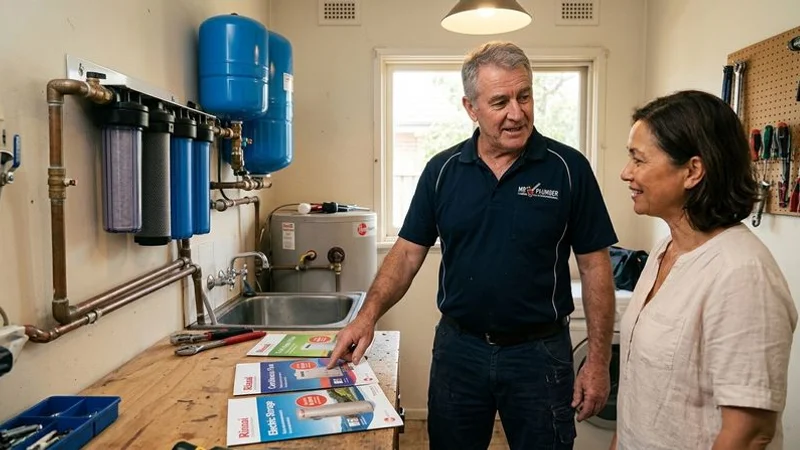
Getting the tank volume wrong guarantees frustration. A tank that is too small leads to cold showers, while an oversized tank burns money heating water nobody uses.
Sizing Guide by Household
| Household Size | Electric Storage | Gas Storage | Gas Instantaneous | Heat Pump |
|---|---|---|---|---|
| 1-2 people | 80 - 125L | 90 - 135L | 16 - 20L/min | 150 - 200L |
| 3-4 people | 160 - 250L | 170 - 260L | 20 - 26L/min | 250 - 300L |
| 5+ people | 315 - 400L | 340 - 400L | 26 - 32L/min | 315 - 400L |
Important sizing factors to evaluate:
- Multiple bathrooms drastically increase demand.
- Freestanding baths require massive volumes of water compared to short showers.
- Connection to off-peak electricity tariffs requires a much larger storage tank.
- A 315L unit is generally the absolute minimum size recommended for properties running on an Off-Peak 2 tariff.
Our technicians always calculate your specific usage patterns before recommending a system size. If your home only receives power to heat water between midnight and 7 AM, a small 160L tank will run dry by lunchtime.
Sizing up correctly ensures consistent comfort throughout the entire day.
Repair vs Replace: When Is Replacement the Better Option?
Deciding whether to patch up an old unit or install a brand-new system requires a logical assessment. Age and component availability are the biggest determining factors.
Our service logs show that electric units older than ten years frequently develop secondary faults shortly after a repair.
You should opt for a complete replacement if:
- The required repair quote exceeds 50 percent of a new system’s total cost.
- You are transitioning from an old electric element to a highly efficient heat pump.
- The external casing shows visible rust or signs of structural bulging.
- The internal tank cylinder is leaking from the actual body, rather than a replaceable fitting.
A leaking cylinder wall indicates fatal internal corrosion. This structural failure cannot be welded or patched safely.
If your system is relatively young and simply experiencing a tripped breaker or a faulty thermostat, repair is absolutely the smartest choice.
We highly recommend reviewing our detailed troubleshooting guide to properly diagnose minor faults before calling a professional.
Tips for Keeping Costs Down
Smart maintenance habits will protect your initial investment for over a decade. Small proactive choices prevent catastrophic, expensive failures.
Our plumbing crews have seen well-maintained tanks last more than fifteen years in Sydney.
Here are the most effective strategies to control costs:
- Swap like-for-like: Changing fuel types or moving the tank location drastically increases labour hours.
- Prioritise energy efficiency: Heat pumps cost more on day one, but they slash quarterly electricity bills.
- Compare comprehensive quotes: Ensure every quote explicitly lists the removal of old rubbish and compliance certificates.
- Change the sacrificial anode: This magnesium rod attracts corrosive elements in the water to protect the steel tank. Replacing this $100 part every five years can double the lifespan of your system.
We have compiled a complete checklist on extending your hot water system’s life that covers these maintenance routines in detail.
Regular servicing prevents sediment buildup and keeps heating elements working at maximum efficiency.
Get a Replacement Quote
A failing unit will not fix itself. Upgrading to a modern, energy-efficient system will secure reliable hot showers and significantly lower your monthly power bills.
Our dedicated team supplies and installs all premium brands of hot water systems throughout Sydney. Transparent, upfront pricing is standard practice for us to completely eliminate nasty surprises on your final invoice.
If you are still wondering exactly How Much Does Hot Water System Replacement Cost in Sydney? for your specific property, reach out today.
Call Mr Plumber on 1800 247 474 to schedule an immediate assessment and secure a fixed-price quote.